The Wardrobe Myth of the Perfectly Matching Outfit
The perfectly matching outfit can feel stiff. Use one deliberate point of connection to make separate colours, textures and pieces feel considered.
You stand by the hall mirror with a navy coat in one hand and a brown bag in the other, wondering if the colours are allowed to meet. They are. A perfectly matching outfit is not the only route to looking put together; often, one deliberate point of connection is enough to make distinct pieces feel considered.
Let one connection do the work
Matching asks two or more things to repeat: the same shade, print, material or set. A point of connection is looser. It gives the eye a small clue that the pieces belong in the same outfit, without requiring them to be twins.
That clue might be a shared undertone, a repeated shape, a texture that appears twice, or a colour picked up in a small detail. The rest of the outfit can differ. Think of it as a thread running through a composition, not a uniform.
Start by choosing the piece you most want to wear. If it is a rust-coloured skirt, you need not hunt for a blouse in precisely the same rust. A cream top can echo the skirt’s warmth; a dark brown shoe can give that warmth a quiet anchor. The connection is the warm palette, not an exact colour match.
Use colour relationships rather than identical shades
Colours that sit near one another can feel calm together: olive with moss, plum with burgundy, or pale blue with slate. These combinations have kinship without looking like a coordinated set. For contrast, pair a muted colour with a clear one, then repeat one of their qualities elsewhere.
For instance, a vivid red scarf can sit comfortably with a charcoal coat if the outfit also contains a warm note, such as a tan belt or a cream knit. The bridge need not be another red item. It can be warmth itself, carried through a different colour.
Pay attention to undertone. A cool grey and a yellowish beige may feel unexpectedly far apart, while a blue-grey and a cooler stone can share an easy, quiet relationship. Check colours in daylight if you can; indoor lighting can make a combination look warmer or flatter than it does outdoors.
Repeat a shape, texture or detail
Colour is only one way to connect garments. A rounded collar can echo the curve of a bag; a sturdy canvas tote can make sense beside a casual cotton jacket; a narrow stripe can pick up the clean line of a trouser crease. These echoes are subtle, which is why they often read as personal rather than planned.
Texture offers a particularly useful bridge when colours differ. Smooth leather and crisp cotton can share a neat, polished character. A soft wool scarf and brushed suede shoes can make a more relaxed pairing. Contrast can work too: a glossy skirt beside a chunky knit feels deliberate if another detail, such as a simple silhouette, keeps the outfit from becoming visually busy.
Use one or two echoes, not every possible one. If the bag, belt, shoes, scarf and jewellery all repeat the same detail, the outfit can start to look assembled from a formula. Leave some pieces alone.
Build a considered outfit from separate pieces
Try this short sequence when a combination looks almost right but not quite:
- Choose an anchor. Pick the garment with the strongest colour, pattern, shape or personal appeal.
- Add a quieter companion. Use a simpler piece that gives the anchor room rather than competing with it.
- Find one bridge. Repeat a colour family, texture, shape or level of formality in another part of the outfit.
- Check the balance. Look for a single crowded area or an item that seems to belong to a different occasion.
- Remove one unnecessary match. If the outfit already has a clear connection, an extra coordinated accessory may not add anything.
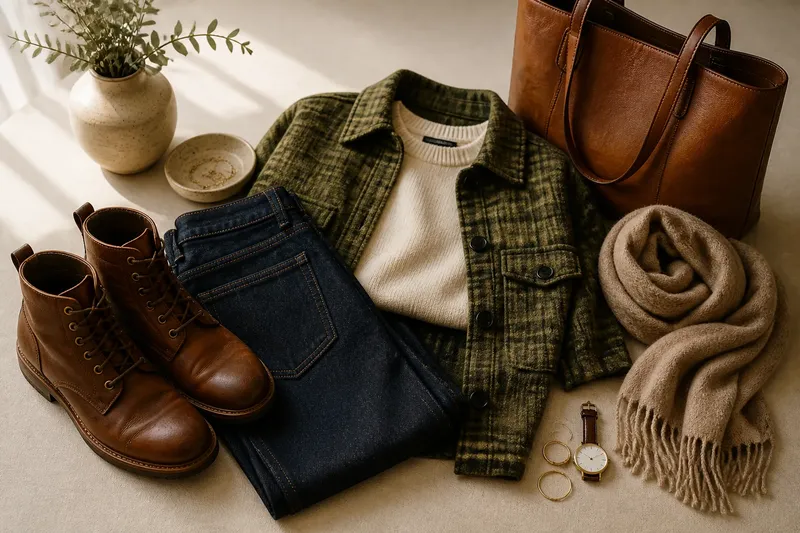
Say you want to wear a green checked overshirt with dark jeans, but your first instinct is to find shoes in exactly the same green. Instead, try brown boots and a cream T-shirt. The boots connect with the earthy quality of the check, while the cream gives the pattern breathing room; the expected result is a relaxed outfit that looks related without appearing bought as a set.
Choose matching when it says something useful
Matching is not a mistake. A same-colour suit can make a strong, clean impression; coordinated knitwear and accessories can look playful; matching separates may suit an event or simply make dressing easier. The point is not to reject coordination, but to notice when it serves the outfit and when it becomes a rule you are following automatically.
Sets also offer a handy starting point for experimentation. Wear the jacket with jeans, or pair the matching trousers with a plain shirt. That breaks the set apart while preserving a familiar colour or fabric relationship. A coordinated piece can become a wardrobe anchor rather than a boundary.
Why does an outfit feel mismatched?
Do shoes and bags need to match?
No. They can connect through tone, material or formality instead. A polished leather bag and neat shoes may feel related even if their colours differ, while a casual canvas bag can make more sense with relaxed footwear.
Can different shades of the same colour work?
Yes, especially when the shades vary in depth or texture rather than looking almost-but-not-quite identical. Try a pale blue shirt with navy trousers, or a soft pink knit with a deeper berry skirt, and let the contrast remain visible.
How can I tell if a print needs a matching colour?
Pick one colour already present in the print and use it as a starting point, not a command. A plain garment in a neighbouring shade can give the print company without repeating its brightest colour exactly.
What if the outfit still looks unrelated?
Check whether the pieces share an occasion and a level of formality before adding another accessory. If a sharp jacket and very relaxed trainers feel disconnected, changing one of those elements may help more than matching their colours.
Keep the useful imperfection
A wardrobe becomes easier to use when its pieces can meet in more than one prescribed combination. Let a striped shirt sit beside a different stripe, or let a favourite bag work with several palettes. The small link might be a repeated shape, a similar mood or a colour that appears only once.
When choosing what to wear, look for a point of connection rather than a perfect match. That single decision can make an outfit feel considered while leaving room for the clothes you already like to remain themselves.