Before Care Labels, Clothes Were Cared for by Habit and Hand
Before care labels, clothes were brushed, aired, mended and washed through household know-how. Learn how those routines worked and where their limits lay.
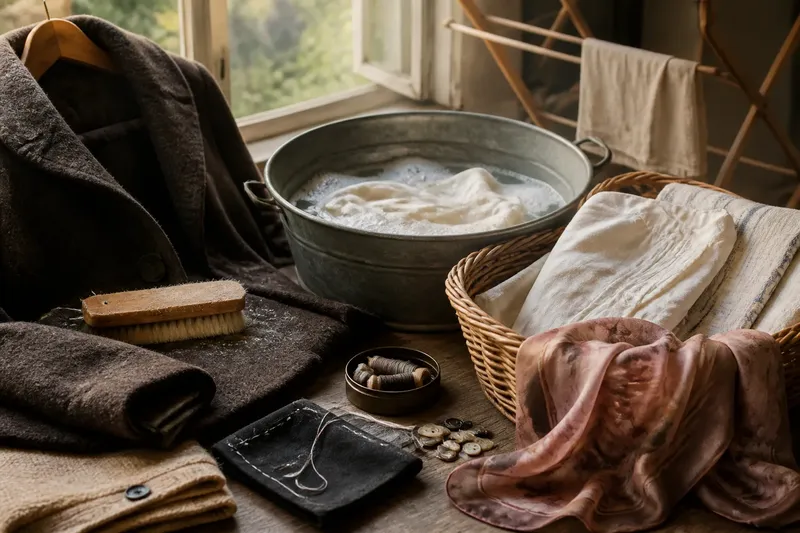
A wool coat comes off its peg with a faint, damp smell, so someone hangs it near an open window and brushes the cuffs. Before care labels, clothes were looked after through such repeated household routines, adjusted by touch, sight and the advice of people who knew the cloth.
Everyday care began with brushing, airing and mending
In homes where garments were worn repeatedly, routine attention could delay a full wash. A brush lifted dust from a coat; airing let dampness escape; a stitch secured a loose button before it went missing. These were practical habits, not a single system used everywhere.
People drew on what they had learnt from earlier garments and from relatives, neighbours, tailors or laundresses. A familiar woollen shawl might be aired rather than soaked, while a sturdy cotton apron could be washed with other household linen. What worked depended on the fabric, the garment’s construction and the facilities available.
Care also meant adapting clothing rather than simply cleaning it. A tailor could alter a hem or replace a worn lining; a household might patch a work garment or turn a collar to extend its use. In places with limited access to laundry services, mending and airing could be especially practical, though habits varied with local resources and household circumstances.
Washing depended on the cloth and the tools at hand
Before a garment carried instructions, its owner had to make a judgement from experience. Water, soap, friction and heat could affect fibres and dyes differently. A method suited to a washable cotton garment might distort wool, loosen a trim or alter a delicate finish.
Household tools shaped the process. A wash tub, soap, a scrubbing board and a clothesline offered different possibilities from a basin and a drying rack. People might spot-clean a mark with a damp cloth, wash an everyday garment by hand, or send a more elaborate piece to a local laundry. Those choices were guided by custom as well as by the garment itself.
Imagine a household with a dark wool skirt, a cotton shirt and a silk scarf, all marked by a rainy walk. The owner brushes soil from the skirt and hangs it to air, washes the shirt in the household tub, and keeps the scarf away from that wash because its colour and finish are uncertain. The visible result is three different care decisions, not one rule applied to every item.
Local knowledge had limits when garments changed hands
A family’s experience could be useful when the same kinds of clothes returned to the wash over time. But advice was harder to apply when a garment came from an unfamiliar maker, passed to a new owner or arrived at a laundry without its history. Someone handling it might not know its fibre, dye, lining or previous treatment.
That mattered particularly for tailored or decorated clothing. The outer cloth was only part of the garment: linings, interlinings, buttons and trims could react differently to water or heat. A coat that looked like plain wool might still contain details that made washing a poor choice.
As ready-made clothing and commercial cleaning services grew in particular markets, garments could travel between makers, retailers, wearers and cleaners who did not share household experience. This did not happen everywhere at the same pace, and it did not erase local care practices. It did create a practical communication problem: how could the maker’s knowledge reach the person who eventually cleaned the garment?
Care labels made instructions travel with the garment
A sewn-in label offered a compact answer. Fibre details and care directions could accompany an item beyond the shop or household where its materials were first understood. For a cleaner receiving an unfamiliar jacket, a written instruction could be more useful than guessing from the surface fabric alone.
Shared wording and symbols also gave people a reference beyond one household’s custom. A common system could distinguish, for instance, between a garment suitable for washing and one that called for professional cleaning. Its value lay in helping makers, wearers and cleaners interpret the same instruction, not in making every garment identical or every decision simple.
Labels have limits. They cannot describe every stain, explain a garment’s full construction or account for every change caused by wear. They are best read alongside the item itself: its seams, lining, fastenings, visible damage and remaining maker information.
Why did clothing care move from household habit to labels?
How did people decide whether to wash a garment?
They relied on experience with the material, the garment’s condition and the tools available. When the cloth or construction was unfamiliar, airing, brushing or asking an experienced cleaner could be safer than assuming a wash was suitable.
Why could a cleaner need instructions from the maker?
A cleaner might not know the garment’s fibre blend, finish or internal structure just by looking at it. A label could carry some of that information to the person responsible for its care.
What did a shared care symbol add?
A recognised symbol could communicate a care limit in a compact form across different makers and services. It worked best when users understood the same meaning, while words could help clarify an instruction.
Did labels make household care knowledge obsolete?
No. Labels can guide washing or cleaning choices, but they do not identify every stain, mend a split seam or decide whether a garment needs cleaning. Observation and repair skills remain useful when a label is missing or incomplete.
What can you do when old clothing has no care label?
- Check for a remaining maker or fibre label; if it identifies the material, use that as one clue, then inspect the garment’s construction before choosing care, otherwise avoid treating appearance as proof of fibre content.
- Look at the lining, trim and fastenings; if one component seems more delicate than the outer cloth, avoid a process that could harm it, otherwise continue assessing the whole garment rather than the surface alone.
- Inspect the mark and the surrounding fabric; if the stain is unclear or the cloth changes colour when damp, stop and ask a qualified cleaner, otherwise consider a cautious, local treatment suited to the known material.
- Check seams, hems and worn areas; if they are weak, avoid vigorous rubbing or agitation, otherwise choose handling that does not put unnecessary strain on the garment.
- Consider the garment’s value and structure; if it is tailored, fragile or especially significant to you, consult a cleaner experienced with that kind of clothing, otherwise use familiar low-risk upkeep such as brushing or airing.
- Look for signs that the garment is merely damp or dusty rather than soiled; if airing or brushing addresses the problem, postpone washing, otherwise seek care appropriate to the material and its construction.
Say you inherit a lined wool jacket with no label, a dusty shoulder and a mark near one button. You check the seams and see that the lining is sound but the cloth around the mark is delicate; you brush away the dust, leave the mark untreated and ask a cleaner familiar with tailored garments to assess it. The result is a clear decision to avoid a guessed wash, while accepting that professional advice is needed for the mark.
Household care left useful clues behind
Before care labels, clothing care was a collection of local practices: brushing, airing, washing, mending and seeking advice from people familiar with a garment. Those habits made sense within the knowledge and resources of a household, but they could not always travel with clothing as it changed hands.
That history helps explain what a label can and cannot do. It carries instructions beyond the people who first knew the garment, while the owner still has to notice its condition and construction. When the tag has disappeared, start with what you can observe and treat uncertainty as a reason to pause, not a cue to guess.