The Button Is Doing More Than Closing a Jacket
Button placement and spacing affect how a jacket hangs, moves and reads. Learn what to inspect before choosing, fastening or altering one.
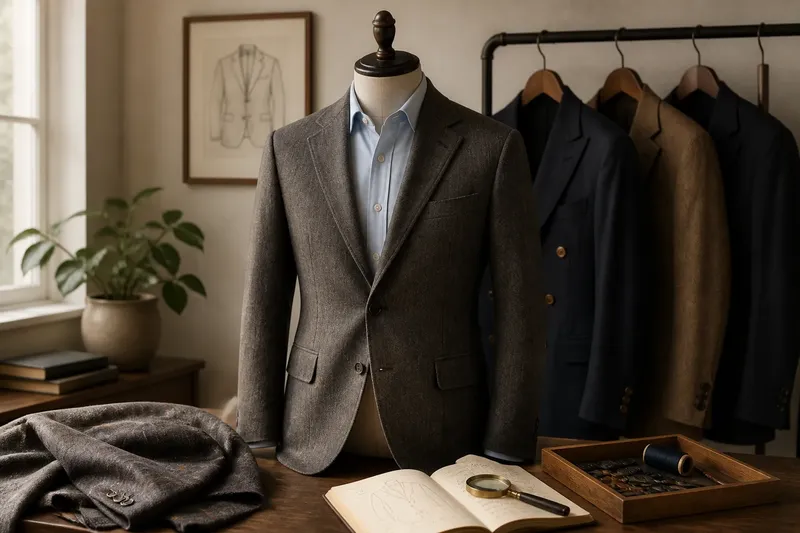
You reach for a jacket, fasten it, then notice the front pulling into a small X. The button is not merely holding the two sides together: its position, the gap between buttons and the direction of fastening all influence how the jacket sits and works. A quick inspection can help you decide whether a jacket suits your routine, needs a different fastening habit or is better left unaltered.
Button placement changes where the jacket closes
Start with the fastening point: the place where a button meets its buttonhole. On a single-breasted jacket, this point determines how much fabric overlaps and where the front draws across the body. A higher closure can make the chest look more covered; a lower one leaves more of the shirt or top visible. Neither is automatically better. The useful question is whether the closure lands comfortably when you stand, sit and reach.
Look at the fabric around the fastening point while the jacket is buttoned. Smooth fronts suggest the overlap is sitting without obvious strain. Diagonal creases radiating from the button or a front edge that swings open may indicate tension, though the cause could also be the jacket’s cut, a tight lining or a posture that changes when you move. Unbutton it and see whether the front relaxes.
On a double-breasted jacket, the overlap is wider and the buttons help set its visual balance. The visible row and the working fastening point may not be the same thing: some buttons are decorative, while an inside anchor button helps keep the inner panel in place. Check which buttonholes are usable before assuming every button is meant to close.
Choose by the way you use the jacket
If you sit often, favour a closure that feels easy to release before settling into a chair. A firm buttoned front can bunch across the waist or pull at the lapels when you sit. For a jacket worn at a desk or on a commute, the practical routine may be to fasten it while standing and unfasten it as you sit, rather than asking the fabric to stay taut.
If you move your arms freely, check the buttoned jacket with a gentle forward reach and an ordinary bend of the elbows. The front should not drag sharply across the chest, and the shoulders should not be hauled towards the fastening. If it feels restrictive, wearing it open may help, but it will not correct a cut that limits movement across the back or armholes.
If you want a neat, closed front, examine the overlap and the spacing together. Buttons set too far apart for the jacket’s front can leave gaps between fastening points; closer spacing may keep the edges aligned, though the overall effect depends on the garment’s shape. Look for the line of the lapels and the edge of the hem as well as the buttons. A closure can be secure yet still make the front look unbalanced.
If you wear the jacket open most of the time, placement still matters. The button position affects where the front edges fall and how the lapels frame what is underneath. Try it over the kind of shirt or knit you expect to wear, then check whether the edges hang evenly rather than twisting towards one side.
Spacing sets the rhythm of the front
Button spacing is both visual and practical. A line of evenly spaced buttons gives the eye a clear vertical path, while a close cluster can make a jacket feel more formal or decorative. On a short jacket, widely separated buttons may leave a long stretch of open front; on a longer one, the same gap can read differently. Judge the spacing on the garment itself, not by counting buttons in isolation.
Notice whether the buttonholes sit level with their buttons and whether the fabric between them lies flat. A button that has shifted on loose thread can make a sound placement look wrong. Before considering a tailor, inspect the stitching and compare both front edges. If a button is loose, re-sewing it in its existing position may restore the intended line; moving it changes how the garment overlaps.
Say you have a jacket that pulls at the middle button when you sit but hangs smoothly when open. You might try leaving it unfastened at your desk and fastening it only while standing. The expected visible difference is less bunching across the waist while seated; if the jacket still tugs when you reach, the issue is likely broader than that one button.
Fastening direction offers a clue, not a verdict
Buttons and buttonholes are usually arranged as a pair, but the direction the front closes can vary by garment and design. On a jacket you own, note which panel lies on top when fastened and where the buttonholes are. That small detail can help you understand how the front is meant to overlap, especially on double-breasted styles with an inner anchor.
Do not treat fastening direction alone as a reliable test of a jacket’s intended wearer or origin. Garments are made for different markets, designs borrow from one another, and a jacket may have been altered. For everyday use, the relevant check is simpler: can you close it without twisting the front, and does the overlap stay put as you move?
What should you check before changing a button?
How can I tell whether a button is decorative?
Try the buttonhole gently and look for an opening that is finished to receive a button. A stitched-down decorative button may have no usable buttonhole nearby, while an inside anchor may fasten to a hidden loop or buttonhole.
Can moving a button improve the fit?
Moving a button can alter the overlap and ease at that point, but it cannot add room to a tight shoulder or back. If the jacket strains in several places, ask a tailor whether the cut is suitable for alteration before changing its closure.
Why does the jacket pull only when I sit?
Sitting changes the angle and space available across the waist and hips, so a jacket that looks smooth while standing may become taut when closed. Unfastening it before sitting is a simple option; persistent pulling in other movements calls for a broader fit assessment.
Should I fasten every button on a double-breasted jacket?
Not necessarily: some buttons may be ornamental, and the working arrangement depends on the design. Identify the usable buttonholes and inner anchor, then fasten only the intended points so the overlap lies naturally.
Inspect before you alter
For a jacket you are considering buying, check the fastening while standing and seated, then look at the front open. For one already in your wardrobe, note whether the buttons are secure, the buttonholes are intact and the overlap rests without twisting. Read the garment’s care and alteration guidance where relevant, and ask a qualified tailor when a change could affect a lined or structured front.
Button placement and spacing are useful clues, not a shortcut to judging a jacket by appearance alone. The best choice is the one whose closure suits how you wear it: comfortable when fastened, easy to release when needed, and balanced when left open. A few ordinary movements in front of a mirror can tell you more than a glance at the button count.